Good Bots, Bad Bots
30.07.2026.30 min read
30.07.2026.30 min read
Summary: Human attention has reached a saturation point, while bots now generate the majority of internet traffic. This research explores how synthetic activity is reshaping digital markets and entertainment economics, and why value migrates to what remains scarce and cannot be manufactured.
The current debate around artificial intelligence in music, entertainment and the creative industries focuses predominantly on content creation. From Suno’s raising $400M1, to Spotify’s collaboration with Universal Music Group2 enabling its users to create AI-powered covers and remixes, to AI video platform Runway raising $315 million to advance its next generation of generative video models3, the industry’s attention is firmly fixed on how content is created. The rapid progress in the large-language-model footrace between OpenAI, Anthropic, Google and others has fueled an even faster wave of generative content, now being released at an unprecedented scale across audio, video and imagery.
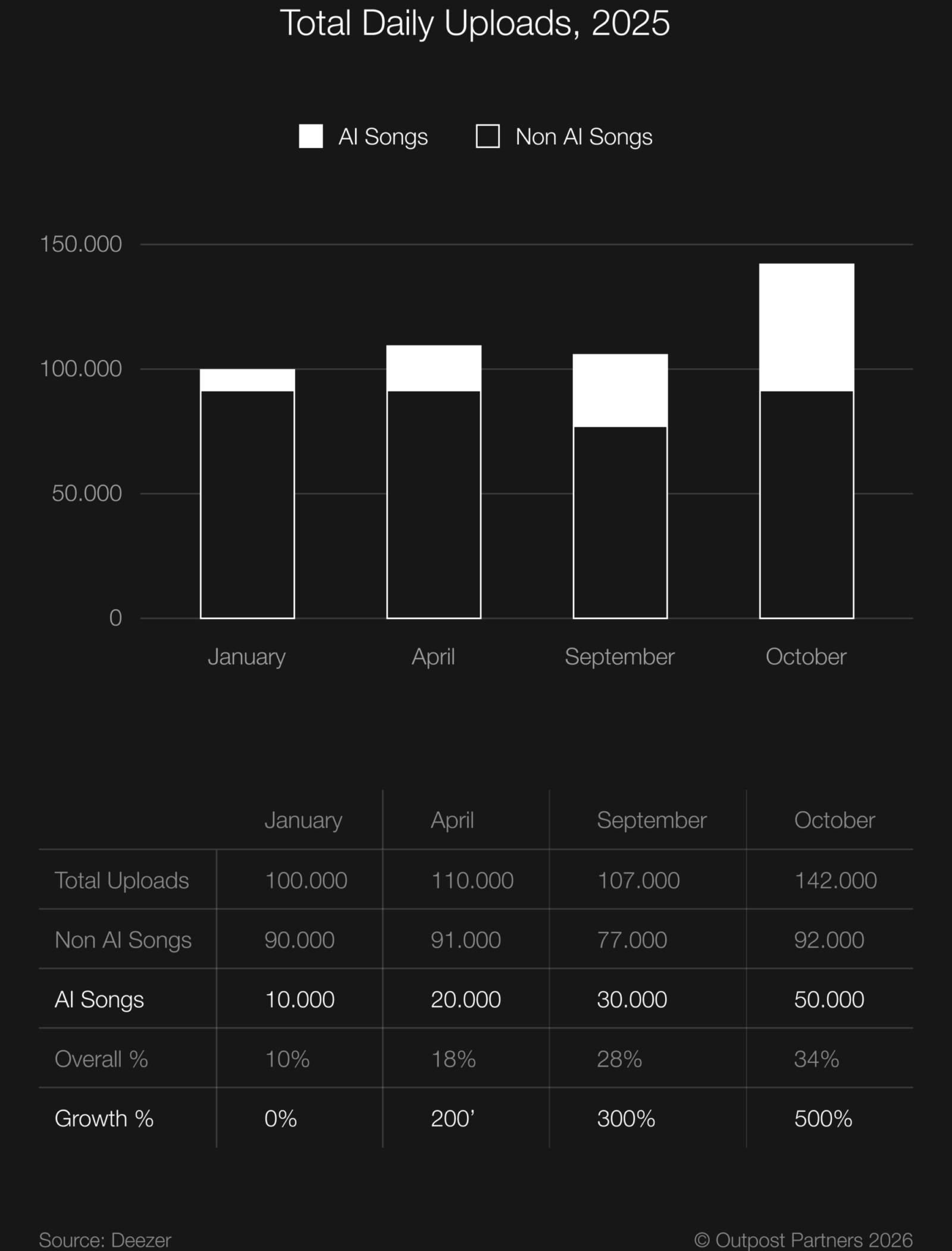
This shift is already visible in music streaming: In January 2025, around 10% of all songs uploaded to Deezer each day — approximately 10,000 tracks — were created using AI. By October, that number climbed to 50,000, and by April 2026 AI uploads hit 75,000 tracks a day, representing around 44% of total uploads4 — more than seven times the number recorded just 18 months earlier. Despite this surge in supply, AI-generated tracks account for only 1–3% of total streams on the platform. Deezer estimates that around 85% of those streams are fraudulent, suggesting that a significant share of the apparent consumption of this music is not driven by human listeners. The scale of output has raised growing concern across the industry that AI-generated content could increasingly displace human-created content and art.
At a fundamental level, there is only a limited amount of attention available. The share of that attention dedicated to media is commonly referred to as media consumption. It is constrained by a daily time budget, determined by how much time people can realistically spend with different media formats. This is what every type of media competes for. The time budget that we allocate to media, appears to be approaching a ceiling:
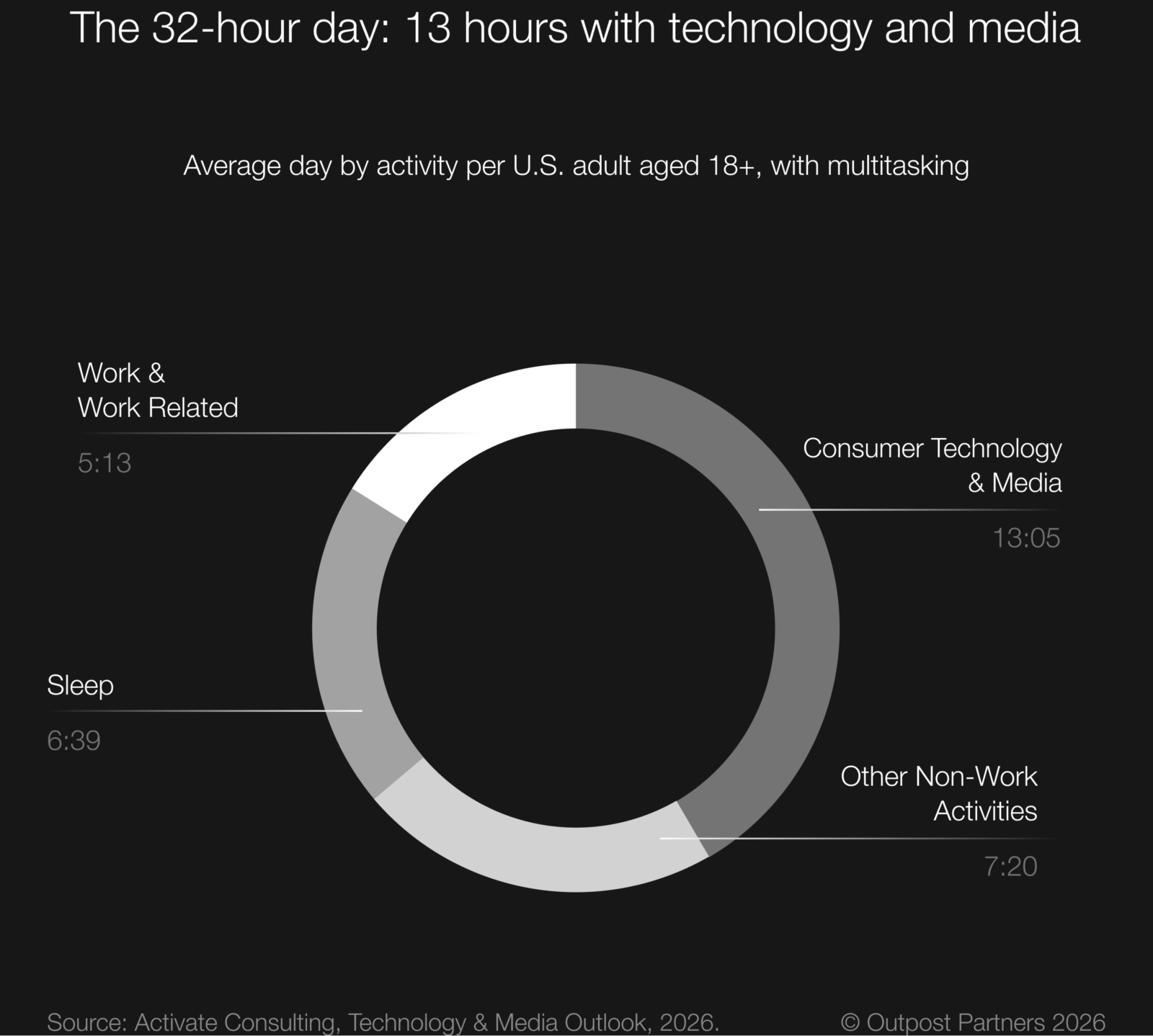
Structural indicators tell a similar story:
The amount of time we spend with media, the shift in preferences and the broader structural signals all point to the same conclusion: human attention devoted to media is no longer expanding meaningfully, even as the supply of content continues to accelerate. The broader digital ecosystem, however, continues to expand. Digital media, overall internet traffic and advertising spend have all continued to grow year after year.
While the media and much of the current discussion around AI focus on generative content, this article looks at the other side of the equation: automated traffic, internet activity generated by machines rather than people. Within that category, the focus is on synthetic activity — the layer where bots, scripts, and AI-enhanced systems mimic human behavior. They stream, watch, and listen, but also comment, share, and like content in place of a real user. This includes “agents”: software that can execute multi-step tasks autonomously (or semi-autonomously) across tools and platforms, often via APIs and integrations, and can generate engagement signals that resemble genuine user activity. Understanding this layer is critical, as it increasingly shapes the dynamics, prices, and incentives of digital markets. More fundamentally, it can erode trust in the numbers and information we encounter across the web.
If human attention is no longer expanding, the question becomes how this growing volume of content is actually being consumed — and by whom.
Automated traffic is not new. Non-human systems have interacted with the web since its early days, initially through simple crawlers and indexing bots that mapped and organized information. For roughly the first 15 to 20 years of the commercial web, this activity represented a relatively small and largely functional layer of internet traffic. According to Imperva’s longitudinal data, in 2015 bad bots accounted for approximately 15% of all traffic, with the majority of automated traffic coming from declared or legitimate bots such as search engine crawlers — good bots11.
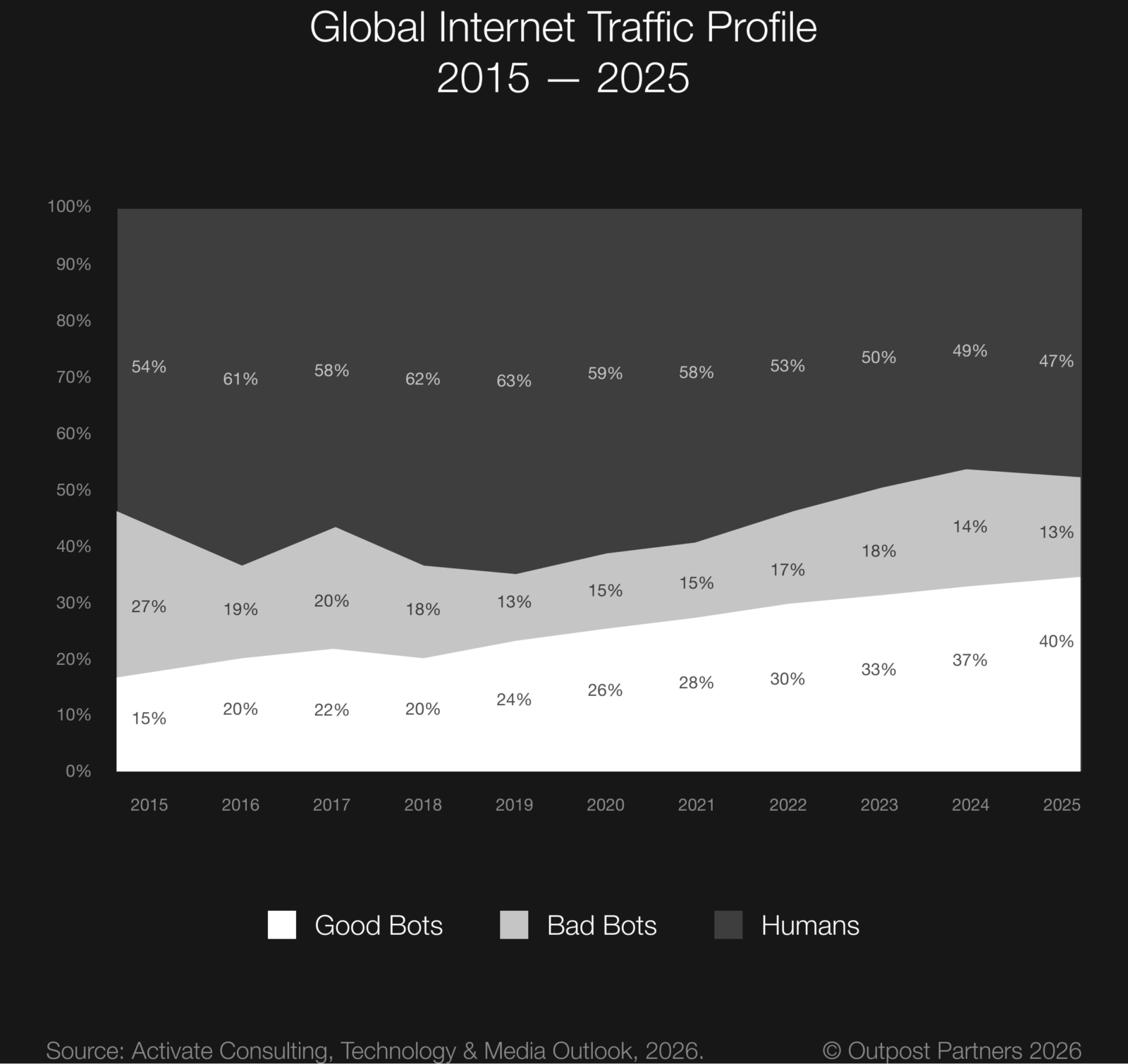
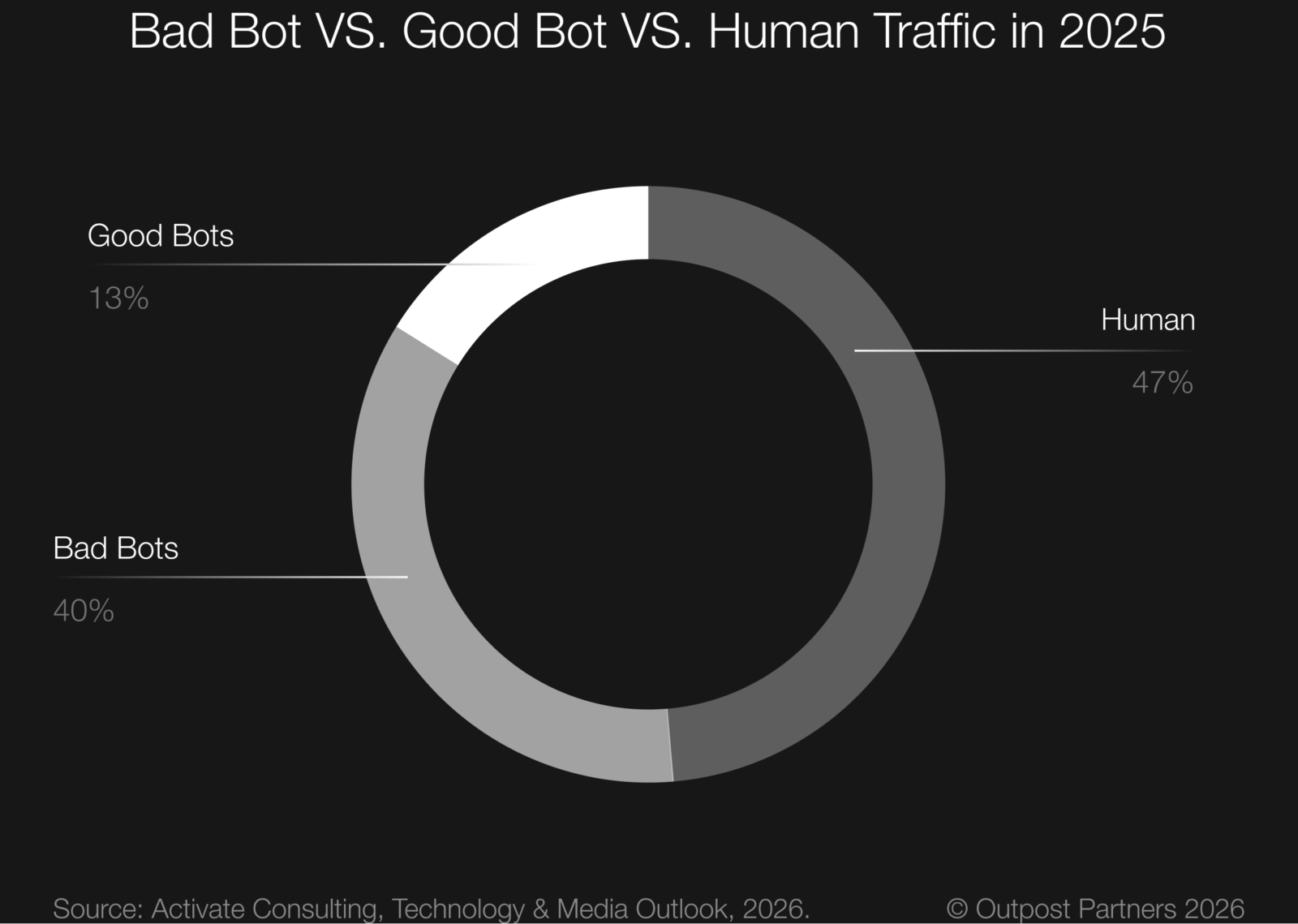
Over the past decade, that balance has shifted. By 2023, bots accounted for nearly half of all internet traffic (49.6%). In 2024, automated traffic surpassed human traffic for the first time, and in 2025 it reached 53% of all global web activity. More than the increase itself, the composition of that traffic has changed. In 2025, approximately 40% of all internet traffic originated from malicious bots and agents, the automated systems designed for scraping, fraud, or manipulation rather than for functional indexing. Thales reports that AI-enabled bot attacks increased by more than 12.5x from 2024 to 202512.
These sophisticated “bad” bots, together with technologies such as headless browsers (browsers without a graphical interface that run in the background and are controlled by code), have accelerated the growth of automated traffic13. At the same time, legitimate bot traffic has also grown significantly. Human interaction with AI-mediated interfaces increased 21x in 2025, highlighting how rapidly these interfaces are becoming the gateway between people and the open web14.
Together, these developments have transformed automated traffic from a supporting layer of the internet into the dominant one, growing far faster than human usage and increasingly shaping how we retrieve and consume information online. In short: human traffic is no longer the majority. Bots — not people — have become the dominant source of internet traffic.
While automated traffic has expanded rapidly, human traffic across the open web has come under structural pressure. This does not reflect declining demand for information or content, but a shift in how that demand is fulfilled.
One driver is the rapid adoption of AI-mediated interfaces for information retrieval. These interfaces — including tools such as ChatGPT, Claude, and Gemini — sit between users and the open web, retrieving and synthesizing material into direct answers rather than routing users to individual websites. In practice, this shifts information consumption away from browsing and toward summarized responses delivered directly within the interface.
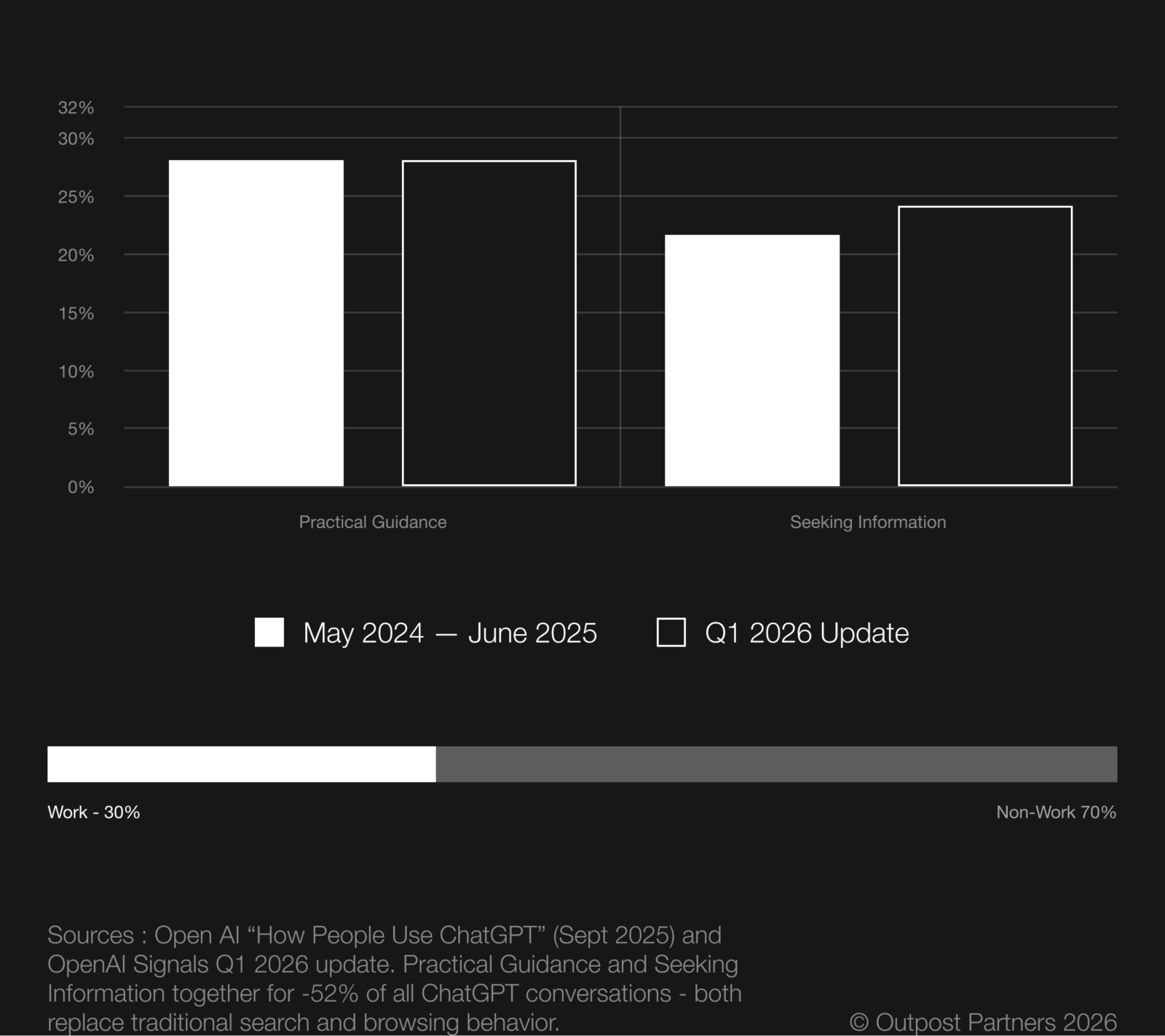
Usage data published by OpenAI shows that a significant share of interactions with large language models is focused on seeking specific information. In OpenAI’s analysis of approximately 1.1 million anonymized ChatGPT conversations, “Seeking Information” (“what is”) grew from 21.3% to 24% between June 2025 and Q1 2026. Together with “Practical Guidance” (“how to”), the two categories now account for 52% of all ChatGPT use – most of which is non-work related15.
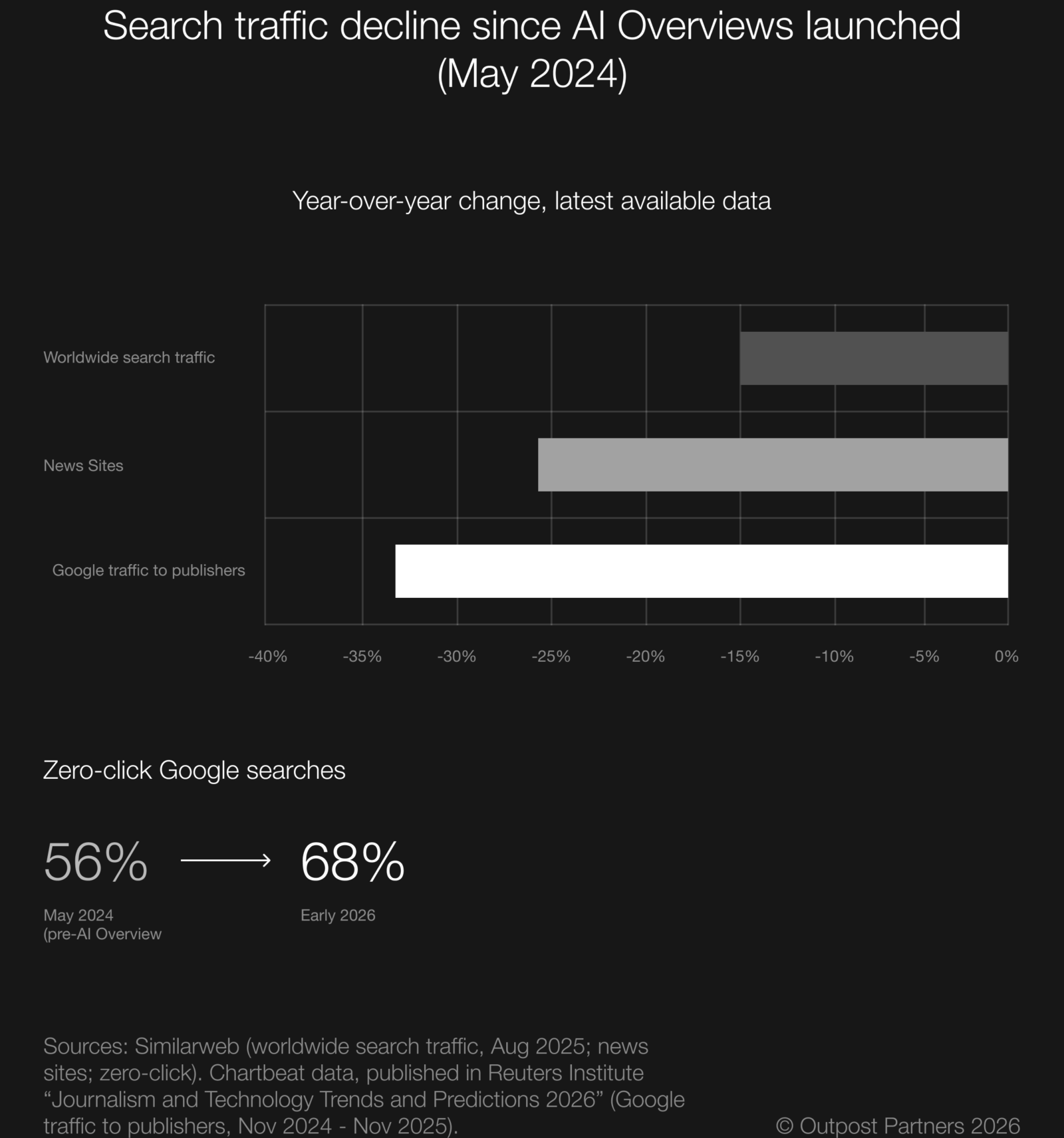
As a result, many queries are resolved without a click-through to the original source, a pattern commonly referred to as zero-click behavior. That behavioral shift is increasingly visible in measurable web traffic data. According to Similarweb, the share of search traffic flowing to content-heavy websites — including news, media, health, and educational resources — has declined steadily since mid-2024, and worldwide search traffic fell 15% over the past year16. Google search traffic to publishers declined 33% globally17. By early 2026, 68% of Google searches ended without a click18.
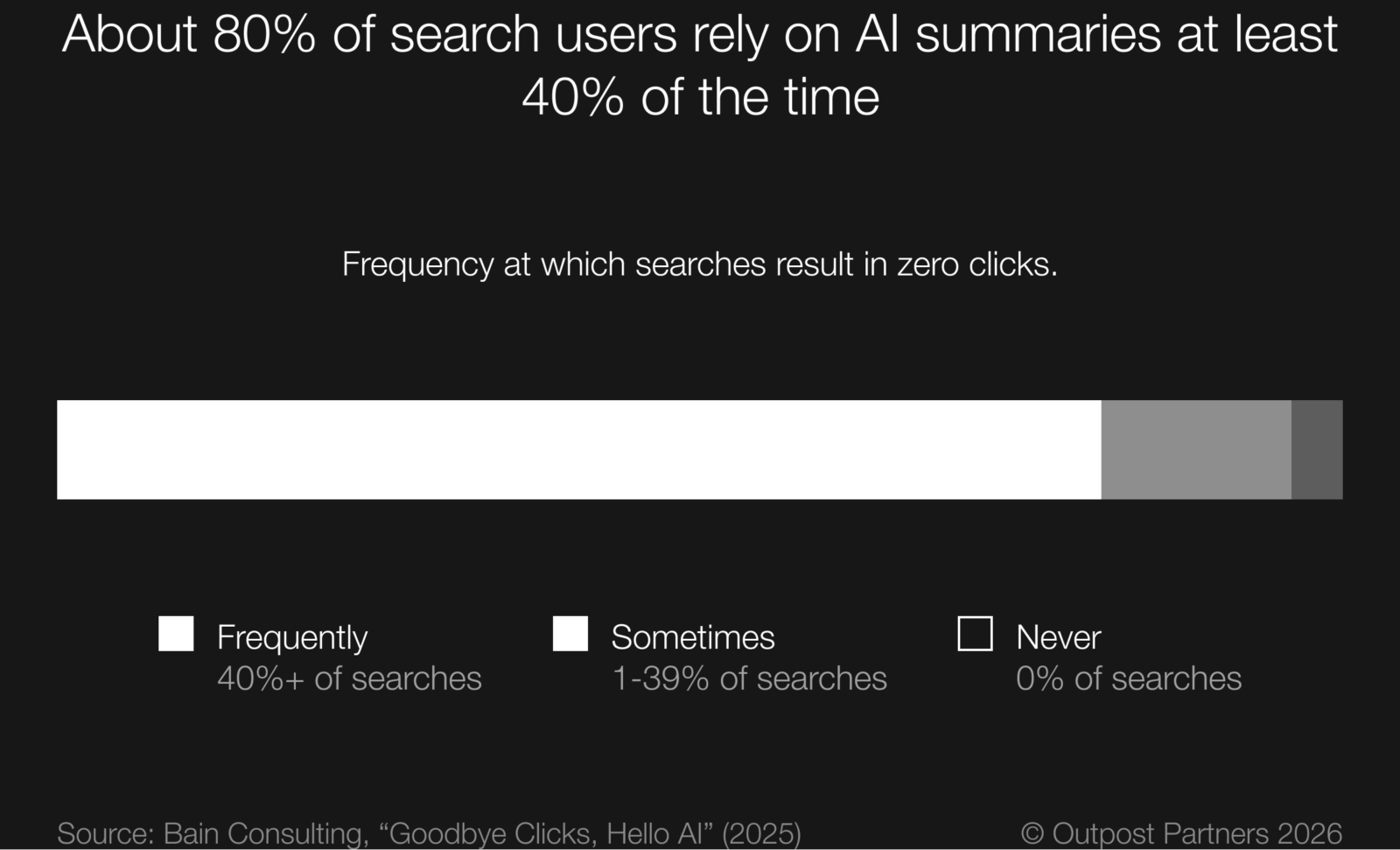
Consumer survey data points to the same trend. A recent Bain & Company survey found that around 80% of consumers rely on AI-generated summaries or zero-click results in at least 40% of their searches, reducing organic web traffic by an estimated 15–25%19.
Google’s response has not been to resist this shift, but to adapt to it. The company has prioritized AI Overviews, featured answers, and generative summaries designed to keep users within the search environment. For users, this reduces friction. For publishers and creators, it means a growing share of genuine human consumption never appears as measurable traffic. The industry is already discussing “Google Zero”: the point at which Google ceases to function primarily as a gateway to the open web and instead becomes an answer engine. This would have massive consequences, as the advertising industry expects that by 2029, in the U.S. alone, more than $25 billion (approx. 14% of total search budgets) will shift into AI-powered search20.
The rise of AI marks a turning point in how traffic is understood. Human consumption is increasingly compressed, mediated, and opaque at the traffic layer, while automated consumption remains highly visible, measurable, and scalable. This imbalance matters, because it reshapes how demand is interpreted, how markets are priced, and how trust is established across the digital economy. One of the central pillars of that economy — and the core business model — is digital advertising.
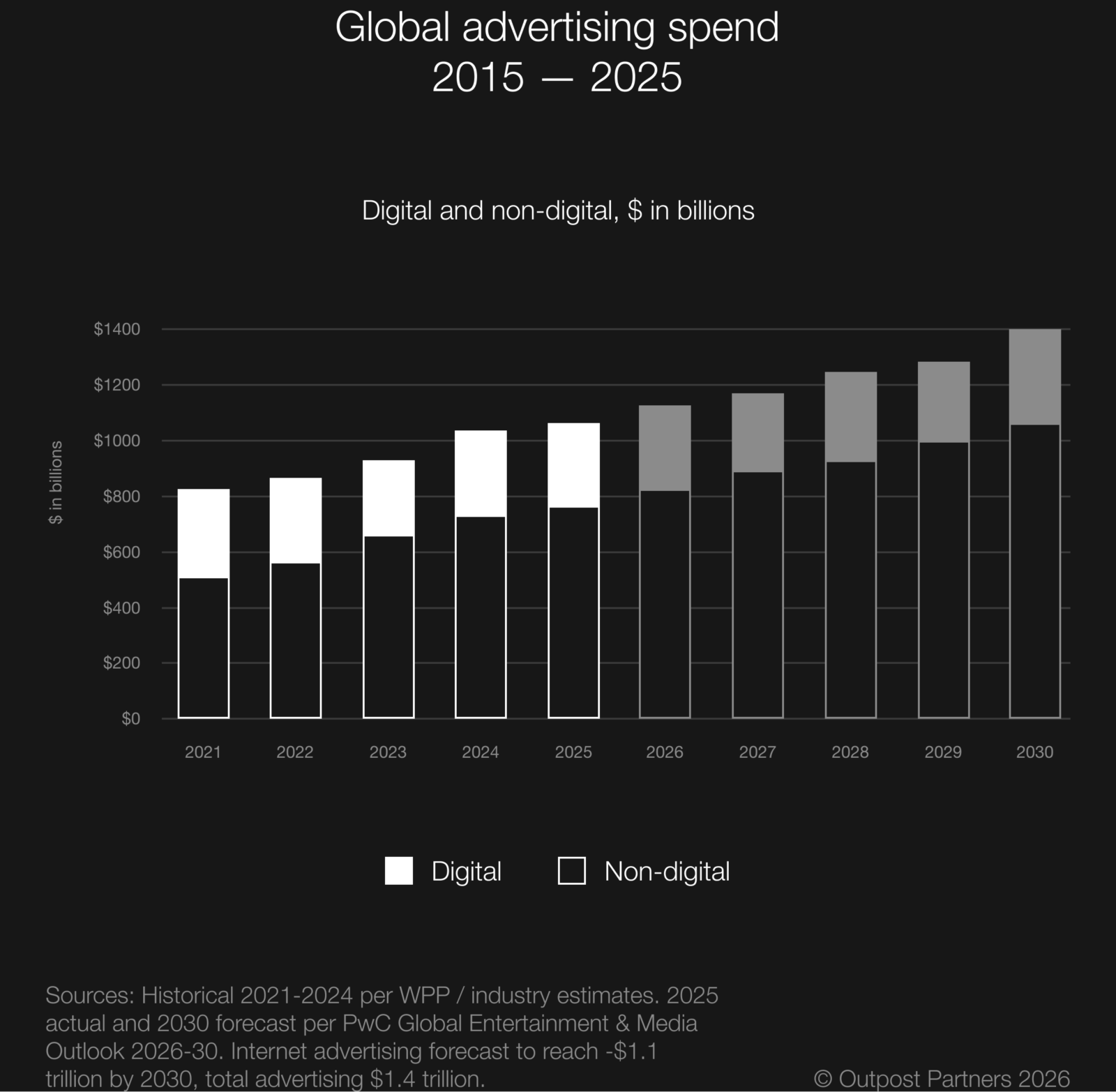
Global digital advertising spend now exceeds $700 billion annually, accounting for 75% of total advertising worldwide21. This is more than twice the combined size of television, print, and outdoor advertising. For comparison, the global value of music copyrights is approximately $47 billion22, while the global games market across mobile, PC, and console reached roughly $200 billion in 202523. While there are overlaps between these sectors, the comparison illustrates the scale and economic importance of advertising as infrastructure.
Historically, advertising monetized attention captured by newspapers, radio, and television. In the platform era, characterized by user-generated content, real-time bidding systems, and hyper-targeting, a small number of companies — led by Google, Meta, and Amazon — captured the majority of this value. The internet dramatically expanded advertising’s reach and efficiency, leaving most content-based business models far behind. Netflix, for example, with more than 325 million subscribers and $45 billion in annual revenue24, has a market capitalization of around $400 billion. Meta, by contrast, has averaged a market capitalization of around $1.5 trillion over the past 12 months — more than the combined market cap of the five largest listed U.S. media companies25. Industry forecasts project continued growth, with total global advertising spend expected to reach approximately $1.3 trillion by 202926.
At its core, digital advertising rests on a simple abstraction: traffic is treated as a proxy for attention, and attention is treated as a proxy for demand. For much of the internet’s commercial history, this assumption held. Human users generated the majority of measurable activity, and advertising systems optimized for reaching people at scale.
As automated traffic has expanded, this premise has weakened. Digital advertising markets do not distinguish between human and non-human demand by default; they have guardrails and fraud detection systems in place, but ultimately respond to what is measurable. Streams, impressions, clicks, views, and conversions are recorded as signals of value independent of who — or what — generated them. This abstraction enables advertising markets to operate efficiently across billions of interactions, but it also introduces a structural vulnerability. Budgets are allocated based on observed activity that may no longer reliably reflect genuine human interest.
As automated traffic increasingly dominates the measurable layer of the internet, advertising systems face a structural gap between what they can measure and what actually reflects human intent. Simply put, these systems detect a view, stream, like, or follow, but rarely understand the context — why it happened. A real fan, a bot, and a coordinated click farm can all look identical if they produce the same measurable output. Detection systems exist and continue to improve, but they operate on imperfect signals and probabilities. At scale, sophisticated synthetic activity that closely imitates human behavior slips through. This blind spot creates two opportunities for exploitation:
This dynamic is already visible across the advertising ecosystem. Investigations and industry studies indicate that substantial volumes of advertising spend flow toward fraudulent or deceptive activity. Research by the Association of National Advertisers suggests that only one out of three dollars spent on digital advertising effectively reaches a consumer. Approximately 35% is lost to invalid traffic, impressions, and made-for-advertising websites (built to maximize ad revenue with low-value content), while a further 29% is absorbed by transaction costs across the ad supply chain27. Even when ads are successfully delivered, effectiveness remains limited. Around 56% are never actually viewed, while other studies suggest that 41% fail to reach the intended person because audience data incorrectly identifies who is viewing the ad28.
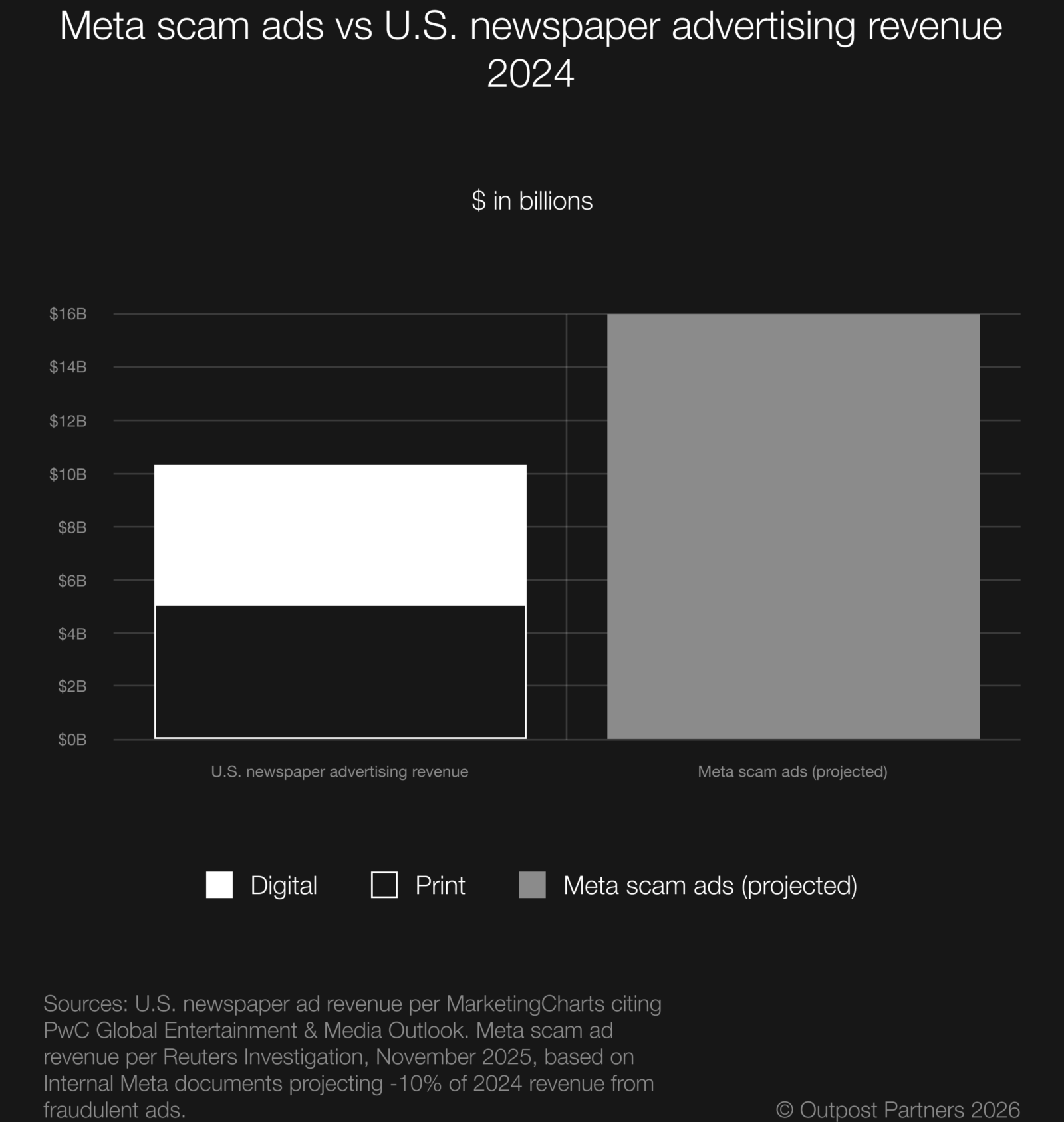
The same pattern is visible at the platform level. Reuters reporting on internal Meta documents indicates that scam and fraudulent advertising accounted for approximately $16 billion, or around 10%, of the company’s 2024 revenue — exceeding the advertising revenue of the U.S. newspaper industry in the same year29. Those documents suggest that roughly 15 billion scam-related ads were shown per day across Meta’s platforms. In cases where accounts were later identified as fraudulent, higher advertising rates were reportedly applied by Meta, illustrating how pricing and delivery systems operate at scale based on activity rather than verified intent.
This pattern extends well beyond any single platform. While industry-wide estimates vary depending on methodology and scope, global losses to ad-fraud, including social media advertising, appear to have surpassed the $100 billion threshold by 202530. Per Juniper Research, approximately 22% of global digital ad spend is lost to fraud annually, projecting that figure to grow to $172 billion by 202831. Independent measurements put fraud rates at 16.7% of ad transactions in the U.S., 19.5% in Europe, and 21.9% in Asia, with rates exceeding 50% in markets like Poland or Ukraine, where bot-networks and proxy infrastructure are concentrated32.
Recent trends suggest these dynamics are intensifying, as generative AI lowers the barriers to developing bots and agents. Easy-to-use code automation tools and AI-enabled platforms that create and distribute advertising assets are lowering the cost and complexity of generating synthetic activity. Estimates indicate that annual ad fraud growth (15%) is outpacing overall advertising market growth (8-9%) by 1.7-2x33.
Advertising markets remain highly efficient at allocating large amounts of capital. But that efficiency also makes them vulnerable to fraud and synthetic traffic. It is important to state that advertising does not cause fraud per se, but it provides the liquidity and scalability that allow synthetic activity to become economically sustainable. This creates a feedback loop in which synthetic activity becomes a persistent part of the ecosystem, normalized and priced into campaigns. The costs are ultimately paid by legitimate advertisers and brands that fund the system, and by users who encounter these scams.
Digital media — music, video, and creator content — with its engagement-based business model, is uniquely exposed to this dynamic. Bots can’t buy products, attend concerts or create real economic demand by becoming paying customers. But they can fake demand or interest in content, artists and tickets, and trigger payout mechanics. This fake engagement can create the illusion of hype, fandom, or popular opinion where none exists. It can encourage users to create content, multiplying reach and relevance. This can manipulate charts, rankings, and especially the recommendation engines that digital media heavily relies on for marketing.
Music streaming offers a clear illustration of this dynamic. Investigative reporting documents the rise of industrial-scale bot farms capable of generating millions of artificial streams per month, using large networks of automated or compromised accounts designed to mimic long-tail listening behavior34. These operations exploit the fact that streaming platforms monetize attention directly. Every play has economic value, without requiring a purchase, subscription, or any further conversion. By the time irregular patterns are detected, monetization and discovery effects may already have occurred. Enforcement is typically retrospective, and system-wide fraud controls have, in some cases, resulted in legitimate independent releases being taken down or monetization suspended.
Outpost’s own research has observed automated streaming systems engineered to simulate human behavior at the session level. In documented cases, bots created playlists mixing one high-profile, legitimate track with one artificial track targeted for boosting. The playlist would be streamed briefly before being deleted, leaving behind a data trail linking the synthetic track to the high-profile one and simulating radio-like listening behavior. Accounts used in these systems were either compromised real user accounts (bought in bulk over illegal marketplaces) or fully synthetic fake accounts. The purpose was not scale alone, but plausibility: to ensure that activity blended into baseline listening patterns and avoided triggering anomaly thresholds.
The same economic logic is visible on social platforms. According to the Spikerz Unwrapped 2025 report, $5.3 billion is lost annually to brand and celebrity impersonation attacks35, with musicians among the most impersonated public figures. Taylor Swift ranked as the most impersonated celebrity globally, with other high-profile artists such as Sabrina Carpenter and Billie Eilish close behind.
Spikerz data shows that 45% of social-media-based cyberattacks involve impersonation, where attackers create fake artist, manager, or support accounts to sell fraudulent tickets, merchandise, or VIP experiences. These scams rely on recognizable branding and credible engagement signals long enough to trigger purchases, after which enforcement typically occurs only once fans have already been deceived.
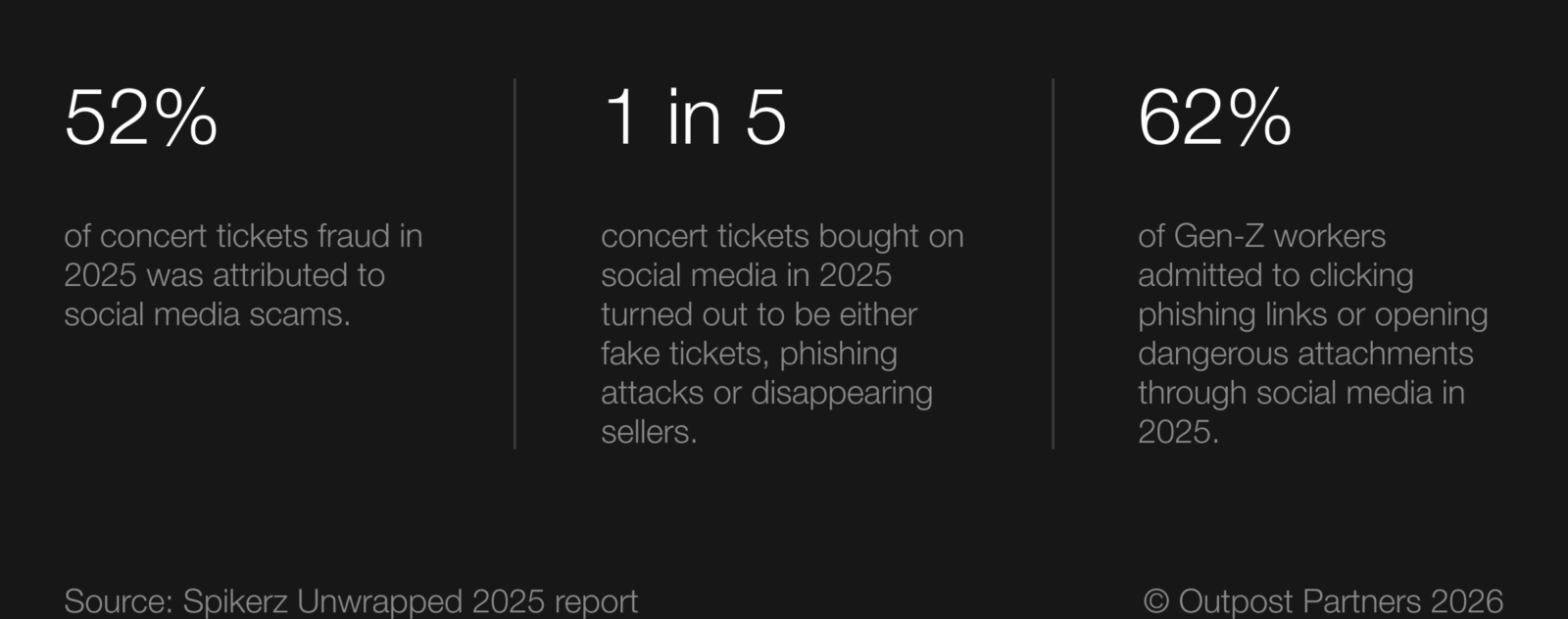
Beyond impersonation, 52% of all concert ticket fraud in 2025 was attributed to social media scams, and 1 in 5 tickets purchased via social platforms turned out to be fake, phishing-related, or tied to disappearing sellers. These losses are not abstract system failures, but direct financial harm for fans and reputational damage for artists.
Fraud does more than extract money; it also distorts measurement by crowding out signals of real demand. Spikerz reports that artist teams spent 15–20 hours per week in 2025 manually moderating spam and harmful comments on social media. These comments are increasingly AI-generated, personalized, and timed to coincide with release drops or tour announcements, making them harder for both humans and algorithms to distinguish from genuine fan engagement.
Floods of automated comments bury real interaction, weaken algorithmic reach, and inflate engagement metrics that labels, promoters, and brands rely on for decision-making.
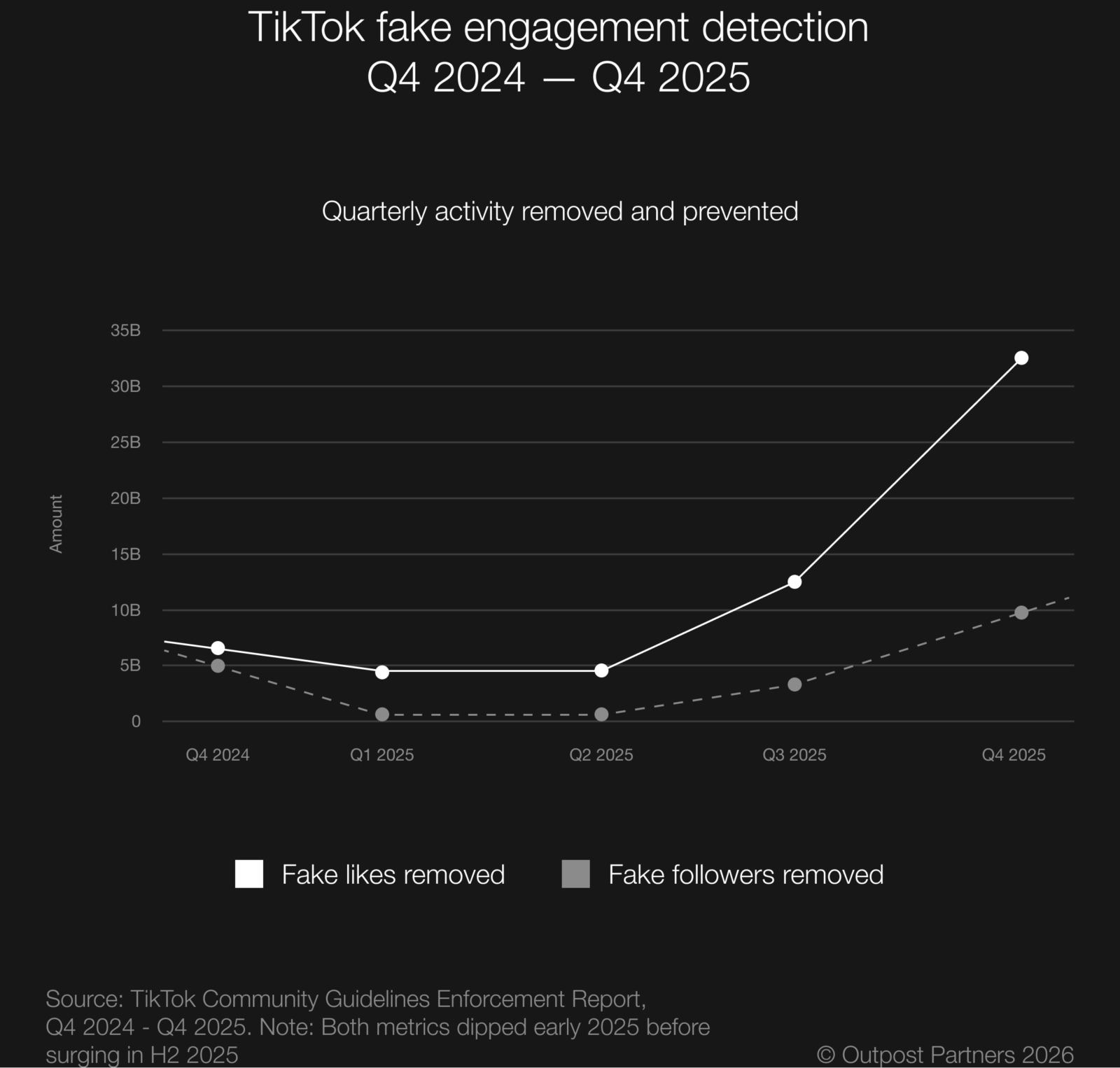
Within entertainment and music, TikTok has become the most influential social video platform. In Q4 2025 alone, the company reported removing 147.7 million fake accounts, 11.32 billion fake followers, and 32.58 billion fake likes36. After a temporary dip in early 2025 — likely reflecting changes in the platform’s automated detection systems — both metrics surged throughout the remainder of the year. Removals of fake followers tripled in Q3, then more than tripled again in Q4. Fake likes climbed 5x in the second half of 2025 alone.
While direct attribution is difficult, the scale and trajectory strongly suggest that automated systems play a substantial role in the growth of fake engagement. The fake activity of these networks — clicks, views, likes — operates at a scale platforms can only partially detect. TikTok itself notes that enforcement against fake likes and followers intensified through 2025, suggesting that inauthentic engagement is not only growing but becoming increasingly difficult to distinguish from real activity.
While Meta does not publish data on automated engagement or bot activity directly, it is likely their social platforms have experienced a similar development. The company says it has become more aggressive in removing accounts and “spammy content” from actors attempting to game distribution and engagement, as this increasingly crowds out real creators37.
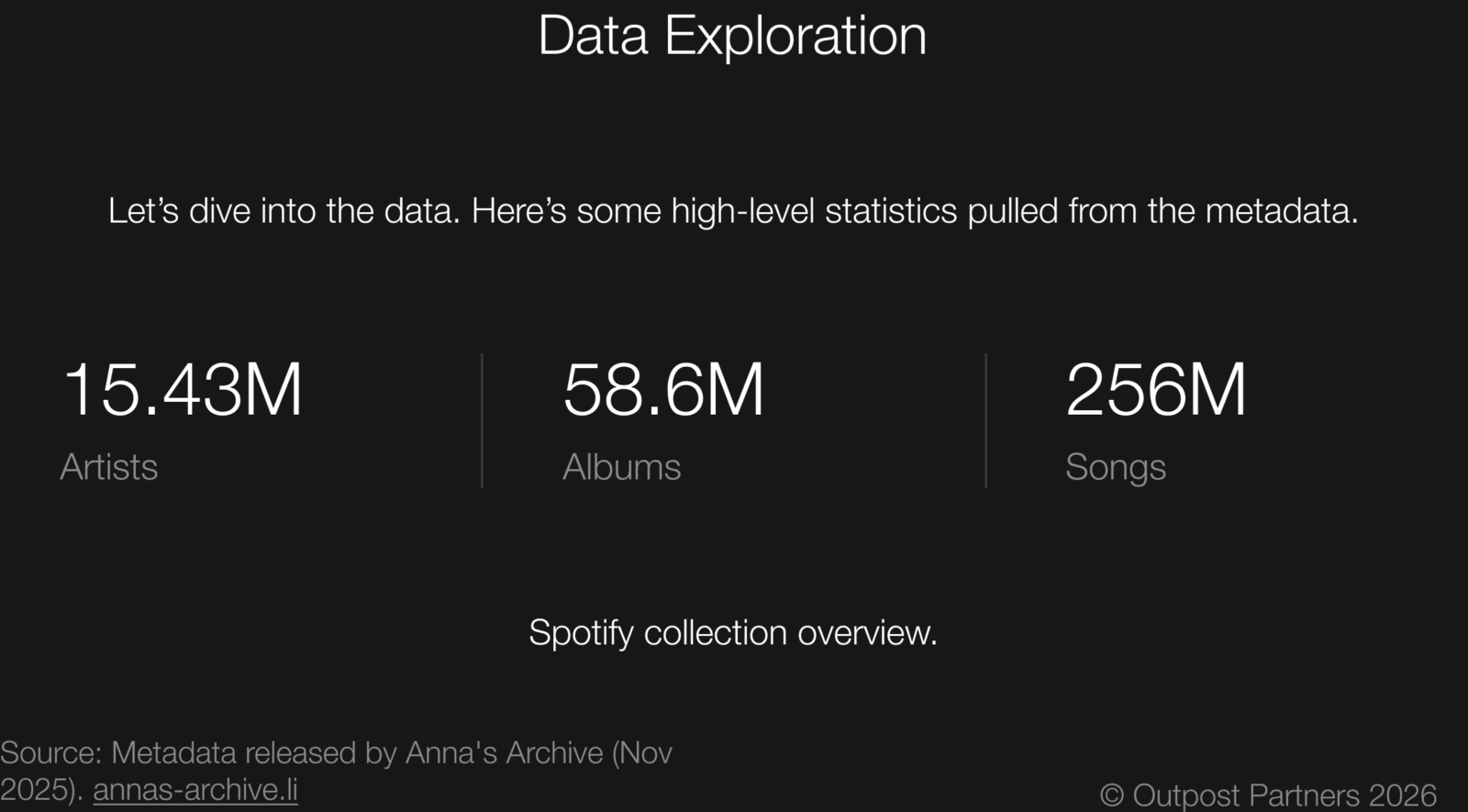
While self-service social media platforms appear particularly vulnerable because of their open nature, automated attacks are by no means limited to them. In late 2025, the pirate group Anna’s Archive announced that it had scraped 99.9% of the metadata for all 256 million songs on Spotify, and around 86 million songs themselves, representing 99.6% of all listens on the service38.
Spotify and the three major labels filed suit against Anna’s Archive in January 2026, initially seeking $13 trillion in damages, around $151,000 per scraped file39. Despite a court order and a subsequent $322 million default judgment, collection remains uncertain because the operators remain anonymous40.
The significance of the case lies less in the legal dispute than in what was extracted. The metadata represents a valuable dataset that can be repurposed far beyond its original purpose. For this research, the released metadata is particularly relevant because it contains essential information:
Notably, the data extraction did not rely on a direct security breach, but on large-scale abuse of legitimate client-layer access paths (third-party applications calling Spotify’s backend APIs), in clear violation of Spotify’s terms and conditions.
What links music streaming, ticketing scams, impersonation, spam, and other forms of digital fraud is not the industry, but the underlying economics. Fraud thrives where it is cheaper to manipulate the system than to create genuine demand and interest. In such environments, fraudulent activity becomes not an anomaly, but a parallel economy.
The following findings illustrate one way in which AI tools, platform incentives, and performance marketing combine into a scalable commercial system.
Earlier this year, Outpost Partners conducted in-depth research on functional music networks on Spotify. The research analyzed over 30 networks: ~1,700 playlists, more than 700,000 track slots, 35M cumulative saves, and over 12,000 Meta ad placements. Functional music — sleep, ambient, meditation, lullabies, pet calming — follows a simple loop: utility-driven discovery, ad-funded acquisition, and passive consumption across playlists. All data has been anonymized, as the point is not the actors but the systematic use of AI tools to create, distribute, and monetize media.
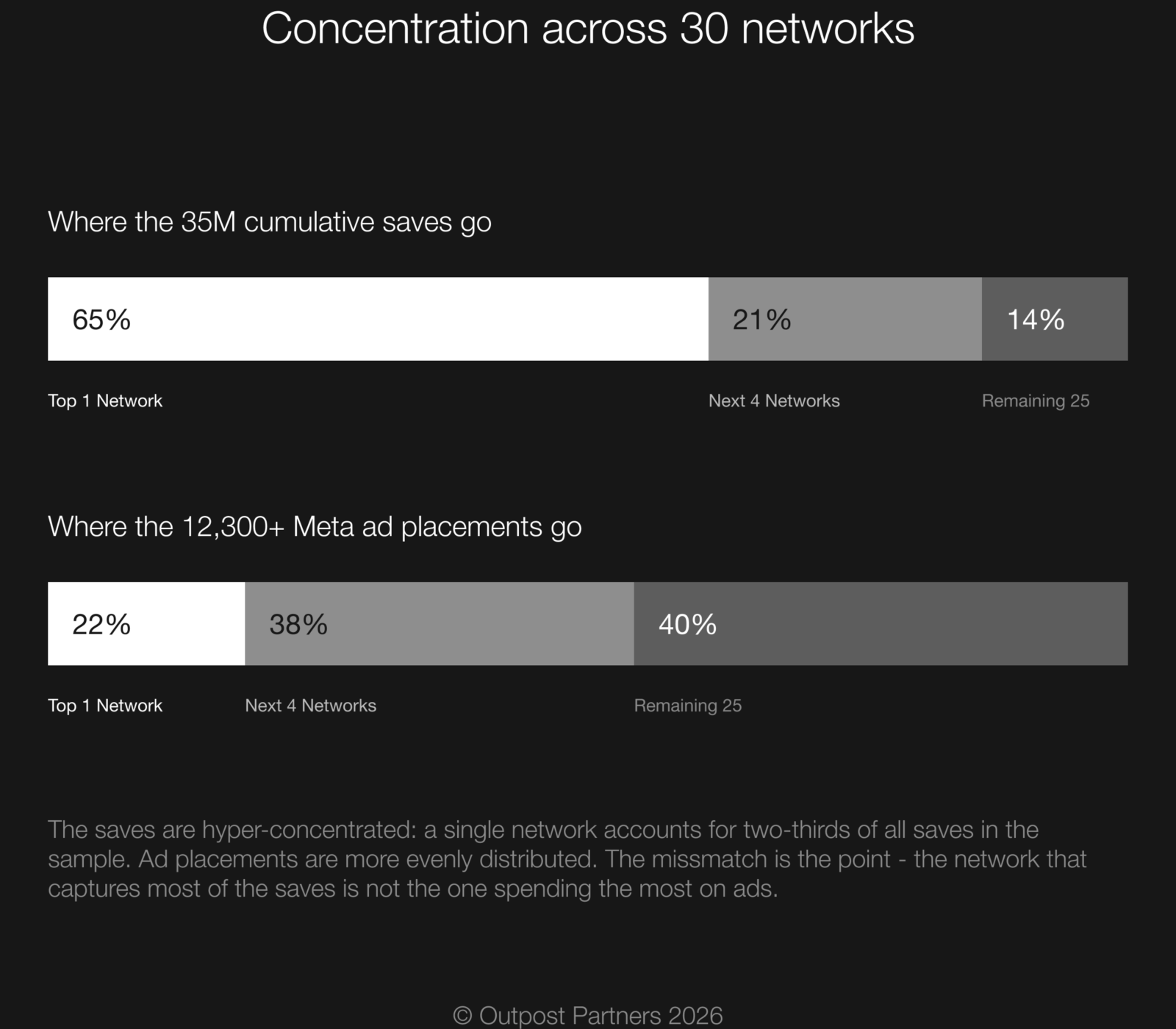
The following four findings describe one layer of the operation.
1. Faceless brands. 96% of the networks operate without a human face. The synthetic identities are created through AI tools: AI artists, personas, brands, and fantasy figures. No real person is attached to the music or the brand. The ads, music, and artwork often appear hand-refined, but the underlying production stack is AI. That stack is the upside: assets for consumption and promotion become extremely scalable and effectively modular.
2. Catalog engineering. Playlists average 446 track slots, with most tracks being 1:00 to 1:35 minutes long — roughly a 9-hour continuous loop. Repetition is high: the same tracks appear multiple times across a single playlist, sometimes in repeating blocks of ~20. Playlists and songs are optimized around Spotify’s 30-second stream-counting threshold.
3. Paid acquisition. These brands rely on ad-funded discovery, there is very little to no organic funnel. On average each network ran 410 Meta ads, with several maintaining more than 2,000 ad sets in their inventory. The ads focused on the use case, varied in style, and were heavily localized (63%) for territory and language.
4. Unit economics. Performance marketing promotes playlists with the goal of extracting multiple streams per acquired listener. The Spotify per-play rate is roughly $0.0015 per stream (blended). Acquisition costs are significant but gradually compress over time as network effects build. The analysis identified two different types of networks:
The investigation focused on the systematic use of the tools and platforms available, not on fraud. What emerged is a self-funding acquisition flywheel: Royalties from streams flow back into more ad spend, and into new music.
AI-generated content, paid acquisition, and Spotify’s payout structure can be combined into a scalable model capable of generating massive streaming volumes and high five- to six-figure monthly royalty payouts. While some of the activity may not comply with platform terms and conditions, the ads and content did not appear fraudulent or misleading. That said, we cannot exclude that some consumption was synthetic, generated through looping techniques, bots, scripts or similar means.
Internet traffic is undergoing a fundamental change. Human activity dominated the first decades of the web, but bots now generate the majority of traffic. Much of this activity comes from malicious bots used for scraping, deception, and fraud. While bad bots are not new, generative AI, large language models, and the rise of agents have made synthetic activity easier and cheaper to produce at scale. It is becoming harder for detection systems to distinguish genuine human behavior from activity generated by bots, farms, and agents.As a result, manufacturing artificial interest can become easier than building genuine demand through products and marketing.
These structural trends pose a challenge for the internet as a whole. For media and entertainment, however, the implications are greater. Human attention has largely plateaued across mature markets, while the supply of content continues to grow, increasingly accelerated by AI. The result is more competition for a pool that is not growing. But competition is no longer limited to individual sectors. Music competes with games, podcasts compete with social media, and video competes with everything else that occupies people’s time. This makes it increasingly important for media companies to understand what is genuinely attracting audiences — and who is actually consuming it.
Entertainment companies no longer compete only with other entertainment companies. They increasingly compete with synthetic activity that crowds out genuine demand and makes it harder to understand what is actually working. As a result, attracting attention is no longer enough — it also becomes increasingly important to know whether that attention is human.
As the supply of content continues to expand, audiences face an increasing paradox of choice. When confronted with overwhelming abundance, people tend to gravitate toward what they already know, as familiarity breeds liking. For entertainment, this intensifies power-law dynamics, concentrating attention around fewer winners, with established artists, franchises, and formats capturing an even larger share than before. The trend is already visible across media:
A consequence is that proven content has become more investable. As consumption concentrates around a smaller number of winners, revenue becomes more predictable. This has attracted increasing amounts of capital from private equity firms and investment funds into music rights and, more recently, YouTube catalogs. The other side of this trend is a growing discovery problem. Breaking new artists, titles, and intellectual property becomes increasingly difficult, not because audiences cannot discover them, but because earning their attention becomes harder.
Overall, one observation stands out: Synthetic traffic and bot farms have shaped internet traffic for more than a decade, yet the public debate has focused overwhelmingly on generative AI. When bots consume content, the issue has received relatively little public attention. When AI creates content, however, artists, creators, and studios increasingly feel displaced by synthetic music, video, games and personalities. The next debate may not be about AI creating content, but about AI consuming it.
Artificial intelligence has not only changed how content is produced for the web, but also how — and by whom — it is consumed. The impact on media and entertainment was expected to be profound, given the nature of digital content. But now the transition is in full swing, and its broader implications are beginning to emerge. These changes will reshape the industry over the coming years. We look at this development through three lenses:
In the short-term, Outpost anticipates more fraud cases and more money being redirected to fraudulent actors as AI gets better at content creation and AI systems become cheaper, more capable, and harder to distinguish from human interaction. Platforms will continue investing in security, detection and verification, but won’t be fully able to eliminate fraud. The technical development of both ends — creation and detection — will dominate this period and drive the conversation, challenge legislation and force the industry to adapt.
Across the media sector, platforms such as YouTube44, Deezer45, TIDAL46, and Bandcamp47 are updating their policies around AI-generated content. There is currently no industry-wide consensus, but several industry bodies are lobbying for standardized labeling of AI-generated and AI-assisted content across media48. We expect more platforms to follow suit and introduce clearer labeling and monetization policies to flag AI-generated content and distinguish it from human creation.
The music industry is at the forefront of this process, as it is traditionally one of the first entertainment industries exposed to new technology and its implications. The contradictory nature of new technology creating an opportunity and being a threat at the same time is illustrated by Suno, one of the leading generative AI music platforms. Suno proposed an AI labeling system for tracks created by its users, while at the same time defending itself against copyright infringement lawsuits from the major record labels for its use of unlicensed recordings to train its models49.
Advertising is also shifting gears and adapting to the rise of the agentic web. Referral traffic from search and social continues to decline, while zero-click behavior grows further, resulting in fewer pageviews and less display inventory to monetize. By Q2 2026, display ad requests had already fallen 40%, underlining the speed of this transition. Publishers are responding with higher advertising prices and doubling down on premium environments, where users are logged in and served editorial content. This premium cannot completely offset the decline, but it helps stabilize advertising revenues50. This could create a recursive trend, where trusted brands avoid traffic that comes through low-quality ads to further raise their prices. Nonetheless, we expect advertising budgets to increase and shift toward LLMs and AI-driven interfaces.
In the mid-term, AI-generated content exceeds human-made content and becomes increasingly abundant. As a result, we expect the value of intellectual property (IP) to grow substantially. In entertainment, IP refers to legally protected assets — such as music, movies, and brands, but also stories, characters, and formats — that can be owned, licensed, and monetized across different channels. While legislation around generic AI-generated content is still unclear, established IP combines legal protection, monetization, and fandom. True IP has been built over the years and requires a catalog, a legacy. Generative AI can produce imagery, music, and films at a rapid pace, but legacy is built on interest over time. AI can generate new stories, but, for now, it cannot engineer legacy.
IP serves as a filter in a world of seemingly endless content and choice. When overwhelmed, people tend to return to what they already know, as familiarity breeds liking. Recognizable IP reduces the effort and energy needed to discover and decide. At the same time, it serves as a platform, creating new ways to engage with audiences — not only through media, but also through products, events, and experiences. In a world with endless content, creating new enduring franchises with cultural relevance will become harder than ever. This growing scarcity will make established IP more valuable.
More capital will flow toward proven and established IP, as well as rights, content, creators and experiences. Discovery could concentrate more around a smaller number of assets, becoming a bottleneck: More content competes for a limited amount of available human attention, which drives up the cost of acquiring attention. As a result, breaking new artists, formats, and franchises becomes more expensive and unpredictable. To mitigate that risk, a growing share of capital will be allocated to extend, market, and monetize existing IP. Ultimately, value shifts from distribution to differentiation.
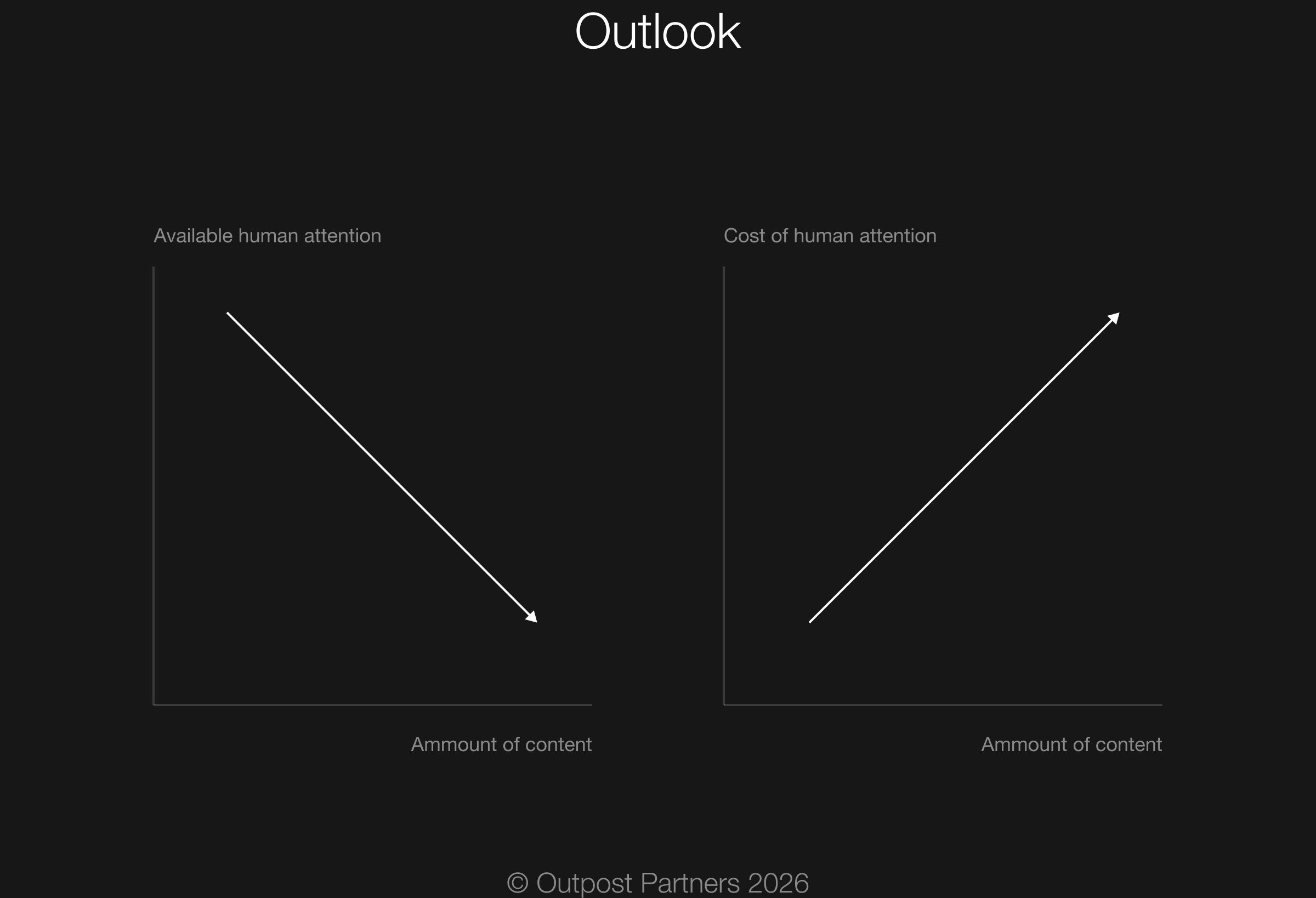
In the long-term, we arrive at an industry where artificial intelligence has moved into the background, as it has been implemented across the value chain. Users have adapted to this new normal.
Before the internet, media and entertainment products were scarce and costly. Not everyone was able to pay or buy the music, movies, or magazines they wanted. The internet changed the equation, and distribution got commoditized. Everyone with access to the web was able to consume videos, music, text, or games, independently of their physical location. In this post-AI world, both bottlenecks have been significantly reduced. The cost of creation and distribution has moved towards zero. Creation is cheap and fast; distribution is automated and agentic. Most internet traffic will be synthetic.
This raises the question: If there is endless content in a world with finite human attention, who is the content being produced for? Artificial intelligence will continue to produce content for both humans and machines, but the balance will tip. In the future, most content created by machines will be for machines rather than people. It will be optimized to be processed by AI systems, and human audiences won’t consume that content. Entertainment will adapt to a new logic: If creation and distribution are no longer scarce, value shifts to what remains scarce, and the incentives for consumption change. Earning genuine human attention will be more difficult — but also more valuable — than ever. We see three trends playing out in the long run:
Not all content competes under the same conditions; it has always been produced for a specific audience or purpose. But with the cost of production and distribution of generic content approaching zero, two distinct categories for content emerge.
One category is content for automated systems rather than people. It can be produced in effectively unlimited quantities, with functional use as the main purpose. This content is optimized to be discovered, indexed, summarized, and processed by algorithms and AI agents. It only needs to be “good enough” to fulfill its purpose and will require only limited audio-visual layers. We call it “utility content.”
The other category continues to compete for human attention. Success will no longer be defined by a function or purpose, or the ability to produce compelling content. Instead, success will be determined by whether it connects with people who actively choose to spend their limited time with the experience. This exchange is not purely informational, but emotional. As humans, we will expect the time we invest in consumption to be matched by intention, creativity and effort from those who create it. Once utility becomes abundant, only content that is personally and culturally relevant to the individual earns attention. We call it “premium content.”
The main discussion in the future won’t be human versus AI, but utility versus human relevance. Utility content will be abundant, but generative AI relies on existing data sets that can only reproduce what is already available. Cultural relevance instead comes from unpredictability that captures the Zeitgeist, resonates with people, and moves culture forward. Such unpredictability cannot be deliberately manufactured. Cultural relevance will be synonymous with human creation.
Media has always rewarded novelty — new movies, albums, or shows. In a world of infinite content, libraries, and on-demand creation, novelty alone becomes less valuable. Importance shifts from access and novelty to selection and context. People no longer simply need something new. They need something relevant for the time, place, culture, or moment they are in. Content relevance can’t be created on demand. It only shows after it is distributed and consumed, making relevant content more scarce than ever.
The way people discover content changes. Instead of sifting through an endless number of choices, they will rely on signals that reduce uncertainty: familiar creators, trusted brands, recommendations from communities. Human creation, voice, and taste become part of the experience itself, making the creator inseparable from the creation. Not only will the result be valuable, but so will who created it and why.
The quality of generative and AI-assisted content will have reached the point where it is nearly indistinguishable from human creation, increasing the risk of fraud and deception. This will move the central challenge from evaluating the content to evaluating its source.
AI per se is not the issue. This challenge arises when there is a mismatch between what people expect and the reality they encounter — when we believe we are engaging with a human, while unknowingly interacting with automated systems or content generated by them. Such mismatches erode trust. The harder it becomes to verify the source and establish authenticity, the more the value of those who can establish transparency and trust increases.
Trust is going to be a deciding factor for people to select what deserves their attention. In an endless stream of content, trust establishes itself as one of the primary filters to choose, reducing complexity by helping people decide who and what is worth listening to. Entertainment will be more about enduring relationships, and less about isolated pieces of content.
The economic implications extend beyond consumption. Trust, human judgment, authenticity and reputation become scarce; individuals and institutions who command them will capture more value and charge premium prices. Utility content will only serve a purpose, therefore its standalone value trends towards zero. Trust will move in the opposite direction, making it the currency of the future.
In an infinite content world, what remains difficult to reproduce grows in value. Artificial intelligence solves functional content, but it does not solve the challenge of consumers seeking meaning through content that brings human connection. Value won’t come from production quality, or the novelty of content, but from the context in which it is experienced. A story, song or film may be decades old, but when it connects to a particular moment in people’s lives, it resonates and creates emotion. Trust, authenticity and cultural relevance become the filters through which people make decisions for entertainment — but they are scarce.
So are physical experiences and live events, as they cannot be created by artificial intelligence or replicated infinitely. Attention starts to shift and the economics of entertainment reorganize — what is unique, rare, and physical becomes more expensive; generic, conventional, and digital are devalued. Intellectual property evolves beyond content into infrastructure. IP is built over decades by converting fans and audiences into communities through memorable experiences and cultural moments. This ensures that instead of being diluted by generic content, it compounds and keeps on attracting attention. This is a form of scarcity that cannot be manufactured overnight.
Value has emerged wherever something meaningful was difficult to obtain. In entertainment, scarcity initially existed in production, through limited resources and funds. With mass production and more infrastructure, it shifted toward distribution and access. With the advent of the internet, distribution was solved and scarcity shifted to attention. In the age of artificial intelligence, it migrates once again — towards trust, cultural relevance, authentic human attention, and experiences that cannot be infinitely generated or consumed by machines.
Scarcity becomes the primary source of value.
———
Author’s Note
This article was originally drafted in January 2026. It remained untouched for five months after a shift in my work. I updated the data before publishing. While parts of the landscape have changed, the central question of this article remains the same. If anything, the developments of the past months have only reinforced the relevance of these issues.
———
Methodology
Sources: Industry reports (Activate Consulting, eMarketer, GWI, PQ Media, Pew Research, Imperva, Thales, Similarweb, Bain & Company, Juniper Research, Association of National Advertisers), platform transparency data (OpenAI, TikTok, YouTube, Deezer, Spotify, Meta), investigative reporting (Reuters on Meta scam-ad disclosures), the Spikerz Unwrapped 2025 report, court filings from the Anna’s Archive matter, and Outpost’s own research on functional music networks conducted with a partner (anonymized).
Tools: AI was used for research, argument stress-testing, and editorial review. The initial draft was written by hand. AI then assisted in refining the language and clarity of the text. The final editorial pass was completed by hand, without AI assistance.
Disclosures: None relevant to the topics covered in this piece.
———
Footnotes
1 https://www.reuters.com/legal/transactional/ai-music-startup-suno-raises-funding-54-billion-valuation-2026-06-03/
2 https://newsroom.spotify.com/2026-05-21/universal-music-group-spotify-licensing-agreements-fan-made-covers-remixes/
3 https://techcrunch.com/2025/04/03/runway-best-Known-for-its-video-generating-models-raises-308m
4 https://newsroom-deezer.com/2026/04/ai-generated-tracks-represent-44-of-new-uploaded-music/
5 Estimates of daily media time vary across research providers, reflecting differences in methodology — notably in how multitasking and concurrent media use are measured.
6 https://www.activate.com/insights
7 https://www.emarketer.com/chart/c/359679/us-adults-will-spend-1255-day-with-media-2026-via-multitude-of-disparate-activities-359679
8 https://www.ft.com/content/a0724dd9-0346-4df3-80f5-d6572c93a863
9 https://www.pqmedia.com/product/global-consumer-media-usage-forecast-2026-2030/
10 https://www.pewresearch.org/internet/fact-sheet/mobile/
11 https://www.imperva.com/resources/resource-library/reports/2025-bad-bot-report/
12 https://cpl.thalesgroup.com/ppc/application-security/bad-bot-report
13 https://www.akamai.com/site/en/documents/state-of-the-internet/2025/akamai-soti-ai-botnet-report-2025-report.pdf
14 https://blog.cloudflare.com/radar-2025-year-in-review/
15 OpenAI “How People Use ChatGPT” (Sept 2025) and OpenAI Signals Q1 2026 update.
16 https://www.ft.com/content/a0724dd9-0346-4df3-80f5-d6572c93a863
17 https://reutersinstitute.politics.ox.ac.uk/sites/default/files/2026-01/Trends_and_Predictions_2026.pdf
18 https://www.similarweb.com/blog/marketing/seo/zero-click-searches/
19 https://www.bain.com/insights/goodbye-clicks-hello-ai-zero-click-search-redefines-marketing/
20 https://www.emarketer.com/content/ai-search-ad-spending-will-climb-with-consumer-adoption
21 https://www.wppmedia.com/news/tyny-midyear-2025
22 https://pivotaleconomics.com/undercurrents/music-copyright-2025
23 https://newzoo.com/resources/blog/global-games-market-q2-2026
24 Netflix Q1 2026 Earnings Release, ir.netflix.net, April 2026.
25 Market capitalizations per Macrotrends, July 2026: Meta compared against the combined market cap of the five largest listed U.S. media companies: Netflix, Disney, Comcast, Warner Bros. Discovery, and Paramount Skydance. https://www.macrotrends.net/stocks/charts/META/meta-platforms/market-cap
26 https://www.pwc.com/gx/en/issues/business-model-reinvention/outlook/insights-and-perspectives.html
27 https://www.campaignlive.com/article/billions-ad-revenue-untapped-due-inefficient-programmatic-advertising-needs-change/1866130
28 https://www.nytimes.com/2023/02/14/opinion/ezra-klein-podcast-tim-hwang.html
29 https://www.reuters.com/investigations/meta-is-earning-fortune-deluge-fraudulent-ads-documents-show-2025-11-06
30 https://www.adweek.com/programmatic/why-ad-fraud-rates-havent-budged-in-15-years
31 Juniper Research, Quantifying the Cost of Ad Fraud: 2023-2028, September 2023.
32 https://www.adweek.com/programmatic/why-ad-fraud-rates-havent-budged-in-15-years
33 https://fraudblocker.com/wp-content/uploads/2023/09/Ad-Fraud-Whitepaper_Juniper-Research.pdf
34 https://www.theguardian.com/music/2025/jun/03/ai-bot-farms-and-innocent-indie-victims-how-music-streaming-became-a-hotbed-of-and-fakery
35 https://www.spikerz.com/blog/spikerz-unwrapped-2025-the-biggest-social-media-threats-facing-the-music-industry
36 https://www.tiktok.com/safety/en/transparency/cg-report
37 https://about.fb.com/news/2025/04/cracking-down-spammy-content-facebook/
38 https://annas-archive.li/blog/backing-up-spotify.html
39 https://www.nme.com/news/music/spotify-major-record-labels-sue-annas-archive-13trillion-allege-brazen-theft-millions-files-3925977
40 https://www.musicbusinessworldwide.com/spotify-and-record-labels-win-322m-default-judgment-against-pirate-site-annas-archive/
41 https://www.boxofficemojo.com/year/world/2025/
42 https://luminatedata.com/reports/midyear-music-industry-report-2025/
43 https://www.bloomberg.com/news/newsletters/2025-09-26/the-video-game-industry-has-a-problem-there-are-too-many-games
44 https://techcrunch.com/2026/07/20/youtube-clarifies-policies-around-ai-slop-and-upsetting-videos/
45 https://techcrunch.com/2025/06/20/deezer-starts-labeling-ai-generated-music-to-tackle-streaming-fraud/
46 https://www.complex.com/music/a/tracewilliamcowen/tidal-ai-music-rules-royalties
47 https://techcrunch.com/2026/01/14/bandcamp-takes-a-stand-against-ai-music-banning-it-from-the-platform/
48 https://www.musicbusinessworldwide.com/record-industry-proposes-ai-labeling-system-for-streaming-platforms/
49 https://www.musicbusinessworldwide.com/suno-sued-by-major-labels-says-transparency-is-important-as-record-industry-proposes-ai-labeling-system/
50 https://digiday.com/media/publisher-ad-supply-fell-by-up-to-40-in-q2-as-ai-search-choked-the-open-web/
This website uses cookies to improve user experience. To learn more take a look at our Privacy policy.
By selecting "Accept cookies" on this banner, you agree to the use and storage of cookies on your device.